
When it's an emergency, someone picks up.
Emergency call routing
After-hours calls are routed by urgency, and a text goes to whoever is on call, so a real emergency reaches a person and a routine request waits until morning.
Price
$345 setup + $25/mo
Fixed and written into your proposal before any work starts. No hourly surprises, no long-term contract.
Add this to a full estimate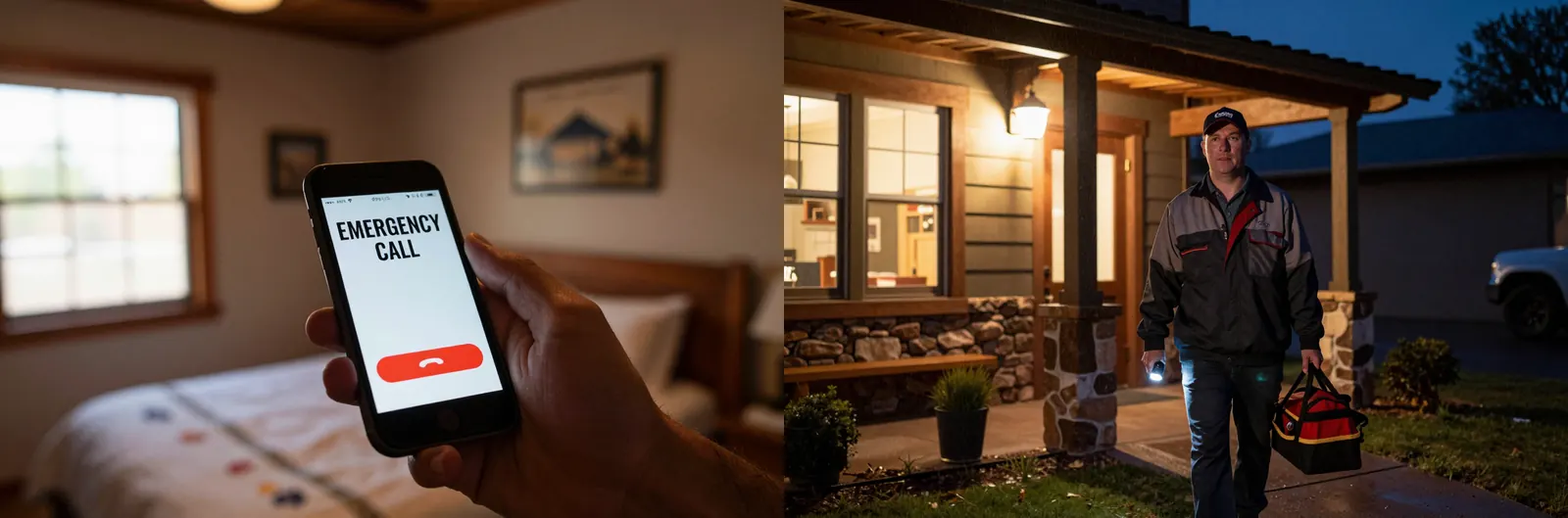
How it works
After-hours calls are sorted by urgency: an emergency reaches whoever is on call, and a routine request waits until morning.
Read the video as text
- A burst pipe doesn't wait for business hours, and a caller who gets voicemail calls the next company.
- After hours, callers hear a short set of options. A real emergency goes through to whoever is on call, who also gets a text.
- A routine request leaves a message that's texted to you and waits until morning.
- You decide what counts as an emergency, and who's on call. There's an emergency button for your website too.
What it is
In plain words.
A burst pipe or a dead furnace doesn't wait for business hours, and a customer with one will call the next company if yours goes to voicemail. But you can't be on the phone all night for every routine request.
This add-on sorts after-hours calls by urgency. The caller hears a short set of options. A real emergency goes through to whoever is on call, who also gets a text. A routine request leaves a message that's texted to you and waits until morning.
A good fit if
- Plumbers, HVAC, electricians, septic, towing, locksmiths and other trades that get urgent calls.
- Businesses that lose emergency jobs to voicemail.
- Teams that share the on-call load.
Probably not for you if
- You never take after-hours work.
- You need a full-scale 24-hour dispatch center. This routes calls and texts; it isn't a staffed service.
We'd rather tell you so than sell you something that doesn't fit.
What you get
Exactly what's included.
Urgency options for after-hours callers
A short menu that separates emergencies from the rest.
Routing to whoever is on call
Emergency calls ring through to the person you've named for that night.
A text to the on-call person
So the call can't be missed.
Messages for routine requests
Left as voicemail, texted to you and answered in the morning.
An on-call schedule
Who's on, and when, that you can change.
An emergency button on your website
So someone who finds you online can reach the on-call person too.
How it goes
You define what 'emergency' means
And who's on call and when.
We build the routing
Menu, on-call rotation and text alerts.
We test it at night
With real calls, from outside your business.
Why it's worth it
What it does for you.
You win the emergency jobs
Being the one who answers is often what decides it.
You still sleep
Routine requests wait until morning.
Shared load
On-call duty rotates instead of sitting on one person.
A better first impression
A clear 'if this is an emergency' message is reassuring.
- One emergency job that would otherwise have gone to voicemail is often enough to cover it.
Run your own numbers
Example figures. Change them to yours.
This doesn't predict how many calls you'll catch. It shows how many extra emergency jobs would pay for it. These are example numbers: change them to your own.
What's left after materials, labor and overhead.
- Setup
- −$345
- Monthly fee for 12 months$25 a month
- −$300
Cost over the first year
−$645
At $180 profit per customer, 4 extra customers in the first year would pay for it. That is the whole claim: we can't tell you how many it will bring.
What this assumes
- This does not predict how many customers you'll get. It only shows how many it would take to pay for it.
The practical bits
What it takes.
What we need from you
- Who's on call and when, and how you want to handle a missed call.
- Your business phone number and who provides your phone service.
- What counts as an emergency for your trade.
How long it takes
Usually one to two weeks. We'll check how your phone line connects before we quote, since it depends on your provider.
Timelines are typical. The dates for your project go in your proposal.
What the monthly fee covers
The monthly fee covers the call routing and text alerts at normal small-business volumes, and keeping the system running.
Questions
Likely questions, answered.
Do I need a new phone number?
Usually not. Forwarding from your current number commonly works. We'll check with your provider before we quote.
What if the on-call person doesn't answer?
You decide the order, and if nobody picks up, the caller can leave a message that's texted to you straight away.
What does it cost to run?
The monthly fee covers normal call and text volume. Tell us if you expect a lot.
Can I change who's on call?
Yes, whenever you like.
What about non-emergencies?
They leave a message and you answer in the morning, or, if you've added workflow automation, they get a text reply right away.
What does Emergency call routing cost?
$345 setup + $25/mo. The price is fixed and written into your proposal before any work starts, so there are no hourly surprises. If you ask for something that isn't in the proposal, we quote that change first and nothing changes until you agree.
Do I own it?
You own what we build for you: the code, the content, and the accounts it runs on (the domain, the hosting account and any service account, such as a payment account, are opened in your name). There is no proprietary platform to be locked into and no cancellation penalty.
Can you add it to the website I already have?
Add-ons are built into a ZONA site. If you already have a site, tell us what it's built with when you get in touch. We'll tell you honestly whether this can be added to it or would work better built into a new one. We'd rather say so than sell you something that doesn't fit.
How do I get started?
Use the button on this page to add it to your project, or send a message. A discovery call takes about fifteen minutes (no pitch deck), and then you get a fixed-price proposal. You'll hear back within one business day.
Is there a long-term contract?
No long-term contracts is our standing rule: care plans are month to month, and any monthly terms for an add-on go in writing in your proposal before you sign anything.