
One stock count, in the shop and online.
In-store inventory sync
Mirror your Square or Clover stock on your website, so you stop selling online what you sold in the store this morning.
Price
$550 setup
Fixed and written into your proposal before any work starts. No hourly surprises, no long-term contract.
Add this to a full estimate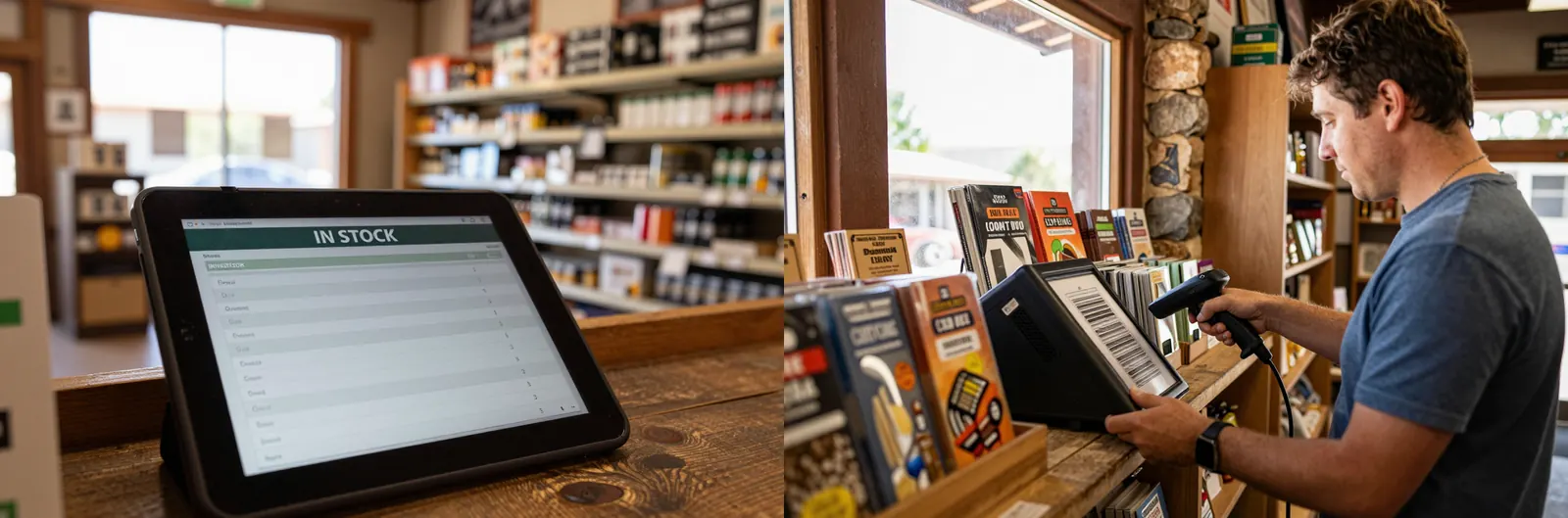
How it works
Your website mirrors the stock count in your Square or Clover system, so sold out in the shop means sold out online.
Read the video as text
- Sell in a shop and online, and every sale in one has to come off the other. When that slips, you sell what you don't have.
- Your website mirrors the stock count in your Square or Clover system, on a schedule.
- When something sells out in the shop, it stops selling online.
- The one thing no sync can fully prevent: two people buying the very last item in the same few seconds.
What it is
In plain words.
If you sell in a shop and online, your stock lives in two places, and every item sold in one needs subtracting from the other. When that slips, you sell something you don't have, then spend a day apologizing and refunding.
This add-on connects your website to your Square or Clover system so both show the same count. It runs on a schedule, and we'll be straight about the one thing no sync can fully prevent: two people buying the very last item in the same few seconds.
A good fit if
- Shops that sell in person and online, from the same stock.
- Retailers already on Square or Clover.
- Anyone who has had to cancel an order because the item was already gone.
Probably not for you if
- You only sell online, or don't use Square or Clover.
- You make to order and don't hold stock.
We'd rather tell you so than sell you something that doesn't fit.
What you get
Exactly what's included.
A connection to your POS account
Your site is linked to your Square or Clover account, using the access you grant.
One stock count
What's in stock in the shop is what the website shows.
Sold-out handling
An item that's out of stock stops being offered.
A scheduled sync
Counts are refreshed on a regular schedule.
Product matching
We line up your POS items with the website's products so each lines up with the right one.
Testing
We sell test items in both places and check the counts.
How it goes
You give us access
You approve the connection inside your POS account.
We match your products
Each item in the POS lined up with its page on the website.
We test both directions
A sale in the shop and a sale online, with the counts checked after each.
Why it's worth it
What it does for you.
Fewer oversells
Customers aren't told 'sorry, we sold out' after they've paid.
No double counting
You stop reconciling two sets of numbers.
Less apologizing
No refunds and no awkward emails about stock you didn't have.
Trust
Customers can believe what the page says.
- The real cost of an oversell is the customer who doesn't come back.
Run your own numbers
Example figures. Change them to yours.
Count what overselling and reconciling cost you. These are example numbers: change them to your own.
Use what you'd pay someone for that hour, or what the hour could earn you.
- Oversell costs avoided3 a month at $25 each
- $68
- Reconciling time you get back3.6 hours a month (we assume 90% of it goes away)
- $108
Net each month
$176
That would repay the $550 setup in about 3.1 months, and about $2,106 a year after that.
What this assumes
- It doesn't count the repeat customers you keep by never disappointing them.
The practical bits
What it takes.
What we need from you
- Admin access to your Square or Clover account (through that company's own approval screen).
- A product list on the website, or the catalog from which we'll build one.
How long it takes
Usually one to two weeks once we have access and your products are on the website.
Timelines are typical. The dates for your project go in your proposal.
Afterwards
It's a one-time price. You own what we build, and if you ever want changes later, we quote them first.
Questions
Likely questions, answered.
Which systems work?
Square and Clover. If you use something else, ask and we'll tell you honestly whether it can be done.
What happens when something sells online?
The sale reduces the shared count so the next shopper, online or in the shop, sees the right number. We'll walk through exactly how it behaves with your POS in your proposal.
What about the very last item?
If two people try to buy the last unit within seconds, one of them can still be disappointed. That's an edge case in any system. If you sell one-of-a-kind pieces, tell us and we'll talk through how to handle it.
Do you need my POS password?
No. You approve the connection inside your POS account.
What does In-store inventory sync cost?
$550 setup. The price is fixed and written into your proposal before any work starts, so there are no hourly surprises. If you ask for something that isn't in the proposal, we quote that change first and nothing changes until you agree.
Do I own it?
You own what we build for you: the code, the content, and the accounts it runs on (the domain, the hosting account and any service account, such as a payment account, are opened in your name). There is no proprietary platform to be locked into and no cancellation penalty.
Can you add it to the website I already have?
Add-ons are built into a ZONA site. If you already have a site, tell us what it's built with when you get in touch. We'll tell you honestly whether this can be added to it or would work better built into a new one. We'd rather say so than sell you something that doesn't fit.
How do I get started?
Use the button on this page to add it to your project, or send a message. A discovery call takes about fifteen minutes (no pitch deck), and then you get a fixed-price proposal. You'll hear back within one business day.
Is there a long-term contract?
No long-term contracts is our standing rule: care plans are month to month, and any monthly terms for an add-on go in writing in your proposal before you sign anything.